Fire alarm upgrades work best when the team treats compatibility, code triggers, phasing, and documentation as one planning problem, not as a simple panel swap. The key is to confirm what can remain, what must be replaced, and what the Authority Having Jurisdiction expects before equipment is ordered.
Upgrade snapshot: Start with the existing record set, verify listed compatibility, ask the AHJ which adopted codes apply, and plan a cutover that avoids unmanaged impairment of alarms, detection, notification, monitoring, and emergency communications.
Start with the existing system record, not the device catalog
An advanced fire alarm upgrade should begin with a document review. The team needs the approved drawings, device addresses, riser diagram, sequence of operations, battery calculations, notification appliance circuit loads, monitoring account details, inspection reports, and a list of unresolved deficiencies. If those records are weak, field verification becomes part of the scope.
The official NFPA 72 National Fire Alarm and Signaling Code is the central reference for fire alarm and emergency communications requirements in many adopted code environments, while local amendments and adopted editions can change what the project must do. That is why fire alarm upgrade planning should include the designer, service contractor, facility representative, and AHJ early.
This first pass also protects related work. A renovation with sensitive areas, for example, may need the same coordination discipline used in cleanroom construction, where shutdowns, pressure relationships, and contamination control cannot be treated as afterthoughts.
Compatibility questions that can make or break the project
Compatibility is not only about plug-in convenience. Fire alarm components are listed to operate as a system, and mixed generations of panels, power supplies, modules, detectors, isolators, speakers, strobes, communicators, and software may not be accepted unless the manufacturer documentation and designer of record support the arrangement.
| Planning item | What to confirm | Why it matters |
|---|---|---|
| Control panel and software | Supported firmware, configuration tools, network cards, annunciators, and migration path | A panel may accept some legacy devices but not all functions or future service tools. |
| Initiating devices | Detector bases, pull stations, duct detectors, monitor modules, and addressable loop limits | Unsupported devices can create nuisance conditions or fail acceptance testing. |
| Notification appliances | Circuit loading, synchronization, candela settings, audibility, and intelligibility where voice systems are used | Visible and audible notification must still match the approved design and local requirements. |
| Power and batteries | Power supply capacity, voltage drop, standby calculations, and charger limits | Added devices can overload circuits even when the panel appears physically compatible. |
| Monitoring and communications | Supervising station path, communicator technology, account transfer, and signal descriptions | A successful local test is not enough if off-site signals are wrong or incomplete. |
Code triggers that deserve early review
Alterations and changes in use
A fire alarm replacement may become more than a maintenance project when the building is renovated, expanded, or used differently. The International Code Council explains that code officials maintain records for permit applications, issued permits, inspections, notices, and orders, so assumptions made during design can become visible during review and inspection through local code enforcement records.
Common triggers include changes in occupancy classification, additions that increase occupant load, phased tenant improvements, new sleeping or assembly areas, changes to accessibility requirements for notification, and work that disturbs fire-resistance-rated construction. The trigger is jurisdiction-specific; the right question is not "Can we reuse this?" but "What does this scope require under the adopted code and approved permit?"
Obsolescence and serviceability
A system can be operational yet difficult to maintain. Obsolete parts, discontinued software, unsupported communicators, or undocumented field modifications can make future testing and emergency service unreliable. That does not automatically mean every device must be replaced, but it does mean the owner should understand risk before approving a partial upgrade.
Planning the cutover without weakening life safety
The cutover plan should show how the building remains protected during demolition, installation, programming, acceptance testing, and retesting. For occupied buildings, a temporary impairment procedure may be required. Notify affected occupants, monitoring providers, insurance contacts, security staff, and emergency response stakeholders according to the facility plan and local requirements.
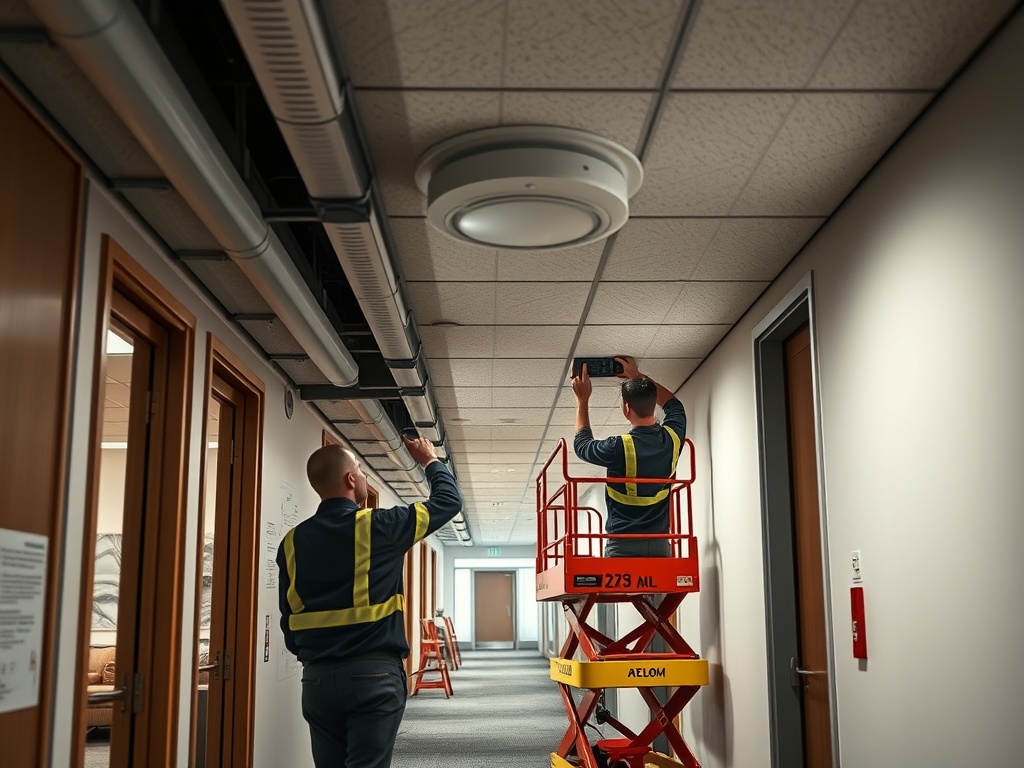
Crews also need the right access methods, lockout coordination, dust control, and device protection. Basic productivity decisions, such as when to use hand tools or power tools around finished ceilings and occupied corridors, can affect damage risk, noise, and rework.
Frequent upgrade mistakes that create rework
- Buying devices before confirming listed compatibility with the exact panel and firmware.
- Assuming existing notification appliance coverage still satisfies the approved layout after partitions move.
- Treating duct detectors, elevator recall, smoke control, door release, or sprinkler monitoring as simple points instead of coordinated interfaces.
- Forgetting that test reports, as-built drawings, programming files, and owner training are part of the handover.
- Skipping coordination with the staff who will receive alarms, silence panels, escort inspectors, and manage impairments.
Closeout checklist for a cleaner handover
- Record the adopted code edition, permit scope, AHJ comments, and approved design decisions.
- Keep compatibility letters, submittals, shop drawings, voltage-drop calculations, battery calculations, and sequence-of-operations notes together.
- Confirm all initiating devices, notification appliances, supervisory points, trouble signals, and off-site monitoring descriptions during acceptance testing.
- Update the asset register and service schedule so technical maintenance teams know what changed. For role clarity, see how custodial and technical maintenance responsibilities should be separated.
- Provide the owner with software files, passwords or access procedures where allowed, inspection forms, device lists, and training records.
Documentation that should survive the upgrade
A fire alarm upgrade creates value only if the owner can operate and maintain it after the contractor leaves. Closeout documents should not be treated as a box of loose papers. The owner needs a clean record that explains what changed, what remains from the old system, which devices were replaced, which circuits were extended, and which interfaces depend on other building systems.
Programming files, point descriptions, panel access procedures, remote annunciator locations, test reports, deficiency corrections, and monitoring account information should be stored where authorized facility staff can find them. If the building changes service contractors later, these records reduce the chance that the new provider will guess at sequences or disable features during troubleshooting.
Owners should also request a short training session that covers normal, alarm, supervisory, trouble, disablement, and reset conditions. The goal is not to turn front-desk staff into technicians. It is to prevent confusion during the first real event after the upgrade.
A safer path for the next project
The best fire alarm upgrade is the one that preserves required life-safety functions during the work and leaves a system that can be tested, serviced, and understood later. Treat this article as educational guidance only; fire alarm design, code interpretation, impairment planning, and acceptance testing should be handled by qualified professionals under the rules of the local jurisdiction.
Before approving a scope, ask for a compatibility matrix, a code-trigger memo, and a cutover plan. Those three documents usually reveal whether the proposal is a true upgrade strategy or only a parts replacement.